

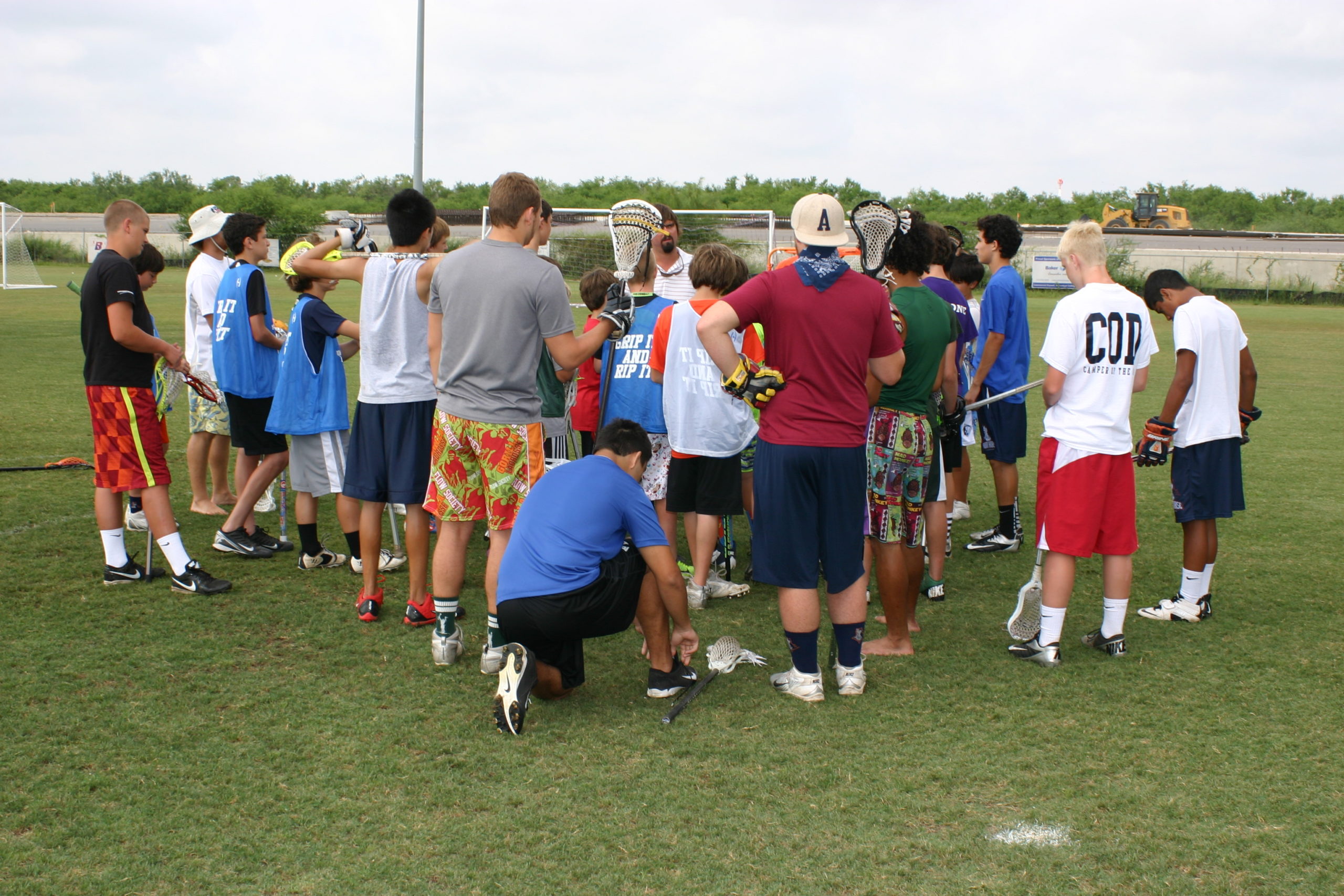
Short, direct answers to the questions San Antonio parents actually type into Google. Every one of these is a real search.
Where can I find lacrosse classes near me in San Antonio?
There are four entry points in San Antonio, and at least one of them is open at any point in the year.
- Clinics — the Speed & Skills Clinic runs September into October. No experience needed, no roster commitment.
- Club teams — the SA Armadillos, boys grades 1–8 and girls 5–8. Tryouts are early September.
- Winter rec league — Saturday mornings, January through February. The lowest-commitment option there is.
- Private training — one hour, one-on-one, any time of year.
- A free clinic every February — grades 1–8, no cost, no equipment required.
For school-based play, youth grades 1 through 8 run through STXYLA, and high school runs through THSLL for boys and TGHSLL for girls. The full local picture — fields, leagues, seasons and who runs what — is in our guide to lacrosse in San Antonio.
How do I start lacrosse?
Borrow a stick and go to one session. That is the entire first step.
Every good program in this city will hand a new kid a stick for a first practice, ours included. Do not buy equipment before your child has held a stick once. After that: pick the next clinic, rec league or tryout on the calendar and show up. What your job looks like from there is covered in supporting your young lacrosse player.
How much does lacrosse cost?
Gear is the one-time cost. Program fees are the recurring one.
- Boys equipment: $300–500 new, or about $250 buying used where it is safe.
- Girls equipment: $100–200 new, or about $120 for the smart mix. Girls need three items. Boys need eight.
- USA Lacrosse membership: $35 a year for a player 22 and under. Effectively required for sanctioned play.
Cost is the single biggest reason kids never try this sport — not interest, not talent, not time. That is why we keep gear on hand. If equipment is the only thing standing between your child and a first season, tell us and we will get them on the field.
The full year-by-year picture — league fees, club fees, tournaments, travel and what is genuinely optional — is in our breakdown of what youth lacrosse costs.
What age should my child start lacrosse?
Any age between six and fourteen is a completely normal place to start, and starting later is not a disadvantage the way parents fear.
Programs run from first grade. But a seventh grader picking up a stick for the first time can absolutely make a high school team — this is not a sport where the eight-year-olds have locked up the roster spots.
The best example in the sport: Charlotte North grew up in Dallas playing basketball and did not pick up a lacrosse stick until seventh grade. She went on to set the NCAA career scoring record and win two Tewaaraton Awards.
| Level | Ages and grades | What it looks like |
|---|---|---|
| First look | Grade 1 and up | Clinics, the winter rec league on Saturday mornings, and a free clinic every February. No experience and no equipment needed. |
| Youth — 6U through 12U | Grades 1–8, through STXYLA | Four quarters that scale by age band. About an hour door to door. No body checking at any of these levels. |
| 14U | Roughly grades 7–8 | The first level where body checking is legal in the boys game. In the girls game, never — at any level. |
| Club | Boys grades 1–8, girls grades 5–8 | Tryouts early September, season September through mid-December. |
| High school | Grades 9–12 | THSLL for boys, TGHSLL for girls. Four 15-minute quarters, because Texas plays NCAA rules. |
| Starting late | Anywhere from 6 to 14 | A completely normal place to start. Charlotte North did not pick up a stick until seventh grade. |
How long is a youth lacrosse game?
Plan for about an hour, door to door.
Most youth games run four quarters, and quarter length scales by age band — shorter at 6U and 8U, longer as players get older. Add warmup and halftime and a typical youth game occupies roughly an hour of your Saturday.
For reference at the older levels: a Texas high school game is four 15-minute quarters, because Texas plays NCAA rules rather than the NFHS rules most states use. That is twelve minutes longer than a high school game in most of the country. If you would like to follow what is happening between those whistles, start with how to watch lacrosse.
What are the lacrosse rules?
There is no single set. There are eight, and your child will play under at least three before they graduate.
The short version: boys play 10 a side with body checking legal from 14U. Girls play 12 a side with no body checking at any level, ever. Box lacrosse is 6 a side indoors with legal cross-checking. Olympic Sixes is 6 a side on a quarter-size field.
Every official rulebook is free, and we have linked all of them in our rules guide.
When does hitting start in lacrosse?
14U. Not 12U.
Body checking is illegal at 6U, 8U, 10U and 12U, and becomes legal for the first time at 14U. This is the most commonly wrong answer in the entire sport, and it is worth knowing before you decide whether your nine-year-old is “too small.” Source: 2026 USA Lacrosse Boys’ Youth Rulebook.
Worth adding: the rules have moved hard toward player safety over the last five years. Head-to-head contact and blindside hits are a point of emphasis for officials every season now. Through high school, even a technically legal shoulder-to-chest hit is a penalty if the player is deemed defenseless and does not see it coming.
When does the lacrosse season start?
- Fall — club season, September through mid-December. Tryouts early September.
- Winter — January to spring break. Rec league and high school tryouts.
- Spring — March through May. The main season for school teams and youth league. The statewide structure is in our guide to boys lacrosse in Texas.
- Summer — May through July. Camps and travel.
What equipment does my child need?
Boys: eight items. Helmet, mouthpiece, gloves, shoulder pads, arm pads, cup, cleats, stick.
Girls: three items. Stick, mouthguard, and eye protection meeting ASTM F3077.
Two pieces carry a mandatory safety certification and both marks must be on the product itself, not the box: the helmet must be NOCSAE certified with the SEI mark, and boys’ shoulder pads must meet ND200. Buy the helmet new — impact history is invisible.
Can girls play lacrosse in San Antonio?
Yes, and the girls’ side here is growing fast.
STXYLA runs girls divisions at grades 1–4, 5–6 and 7–8. High school programs include Alamo Heights, Saint Mary’s Hall, Smithson Valley, TMI, Antonian and Reagan.
Alamo Heights started a girls program in 2023 and won a state championship in 2025 — its third year. That is how open this side of the game still is in San Antonio. Everything else about the girls game is in our complete girls lacrosse guide.
Can my kid play lacrosse in college from Texas?
Yes, and the odds are better than most parents assume — about one in seven high school players goes on to play in the NCAA.
But the honest version matters: Texas has zero NCAA Division I or Division II men’s programs and one Division III — Southwestern University in Georgetown. The realistic in-state path is the MCLA, where roughly twenty Texas college teams compete, including UTSA right here in San Antonio. When to do what, and in which grade, is laid out in our recruiting timeline.
For girls the picture is better nationally — women’s lacrosse has 127 Division I programs to men’s 78, and a girl’s odds at Division I are meaningfully better than a boy’s.
Is lacrosse safe?
It is a contact sport and it carries real injury risk, and you should have accurate numbers rather than reassurance.
Boys lacrosse sits in the upper range of high school sports for injury rate. The rules have moved substantially toward safety over the last five years — no body checking until 14U, mandatory chest protection meeting ND200 after commotio cordis cases, and a sustained officiating emphasis on head contact and blindside hits.
Girls lacrosse has no body checking at any level, and the data on headgear is worth reading before you decide.
How do I explain lacrosse to grandparents?
Someone genuinely searches this, and it is a fair question.
The short version: it is hockey played on grass, with a net on a stick instead of a blade. Ten players a side for boys, twelve for girls. You catch, carry and pass the ball in the head of the stick, and you score in a goal.
The part worth telling them: it is the oldest team sport in North America, invented by the Haudenosaunee long before Europeans arrived, and it returns to the Olympics in 2028 after a 120-year absence.
And one for the dinner table: James Naismith, who invented basketball, played lacrosse at McGill first. Confirmed by McGill’s own athletics Hall of Fame.
Still have a question?
Ask it. Every question on this page came from a real parent or a real search, and the list gets longer every season.
Paul Taylor
Varsity Head Coach, Central Catholic High School
Founder, Great American Lacrosse
Paul Taylor is the varsity head lacrosse coach at Central Catholic High School in San Antonio and the founder of Great American Lacrosse, which runs the SA Armadillos club teams and the Summer Showdown Camp. He has coached lacrosse in San Antonio for over a decade.
Train with Great American Lacrosse
Great American Lacrosse runs year-round programs in San Antonio — the Speed & Skills Clinic, the SA Armadillos club teams, winter rec, private training, and the Summer Showdown Camp. Open enrollment, every level, beginners welcome.