

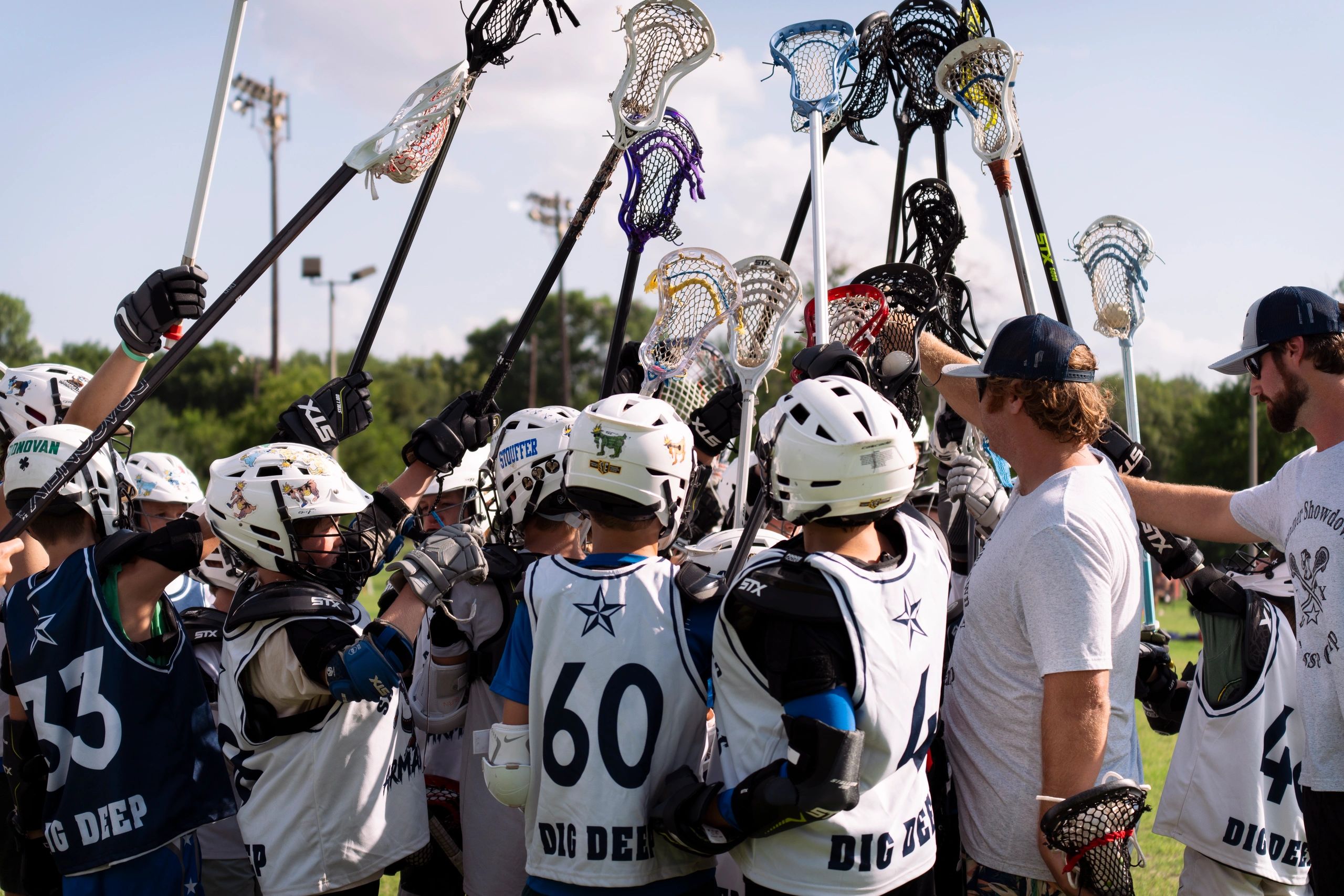
Give a kid a wall, a ball and ten minutes a day, and by spring they will have handled the ball more than a teammate who only touches it at practice. Everything you need to start tonight is below.
Wall ball is a player throwing a lacrosse ball against a flat vertical surface and catching the rebound, over and over, switching hands and switching throws. That is the entire activity — no equipment to buy, no partner to schedule, no drive across town.
It is also the one thing I can point a parent at and honestly promise a result from. A player who does wall ball five days a week gets better.
Why the wall works
Lacrosse is a catching sport before it is a scoring sport. A player who cannot catch cleanly under pressure is not thrown to a second time, and dodging, shooting and defense all sit on top of that one skill. Catching gets built by catching, until the hands do it without being asked.
The wall is the fastest machine ever invented for producing those repetitions. A throw and catch at ten yards takes about two seconds — roughly 30 in a minute, about 300 in ten minutes, from one kid with one ball.
Compare that to a team practice: ninety minutes, twenty-five players, much of it spent in lines. A player in a good practice touches the ball forty or fifty times. The wall gives them that in ninety seconds.
The arithmetic that changes a season. Ten minutes a day, five days a week, is about 1,500 catches a week. Across a twelve-week fall that is roughly 18,000 repetitions — from a kid who never left the driveway.
What you actually need
A wall, a ball, a stick. Gloves if you have them — a player should practice holding the stick the way they hold it in a game.
The wall
Any flat vertical surface that will not be damaged and has no glass above it. Brick or concrete block is the classic — a house foundation, a retaining wall, a fence pillar. The outside of almost any school building works with the campus’s permission. Handball courts are purpose-built and usually empty on a weeknight, and most public tennis courts have a practice backboard. Skip vinyl siding, garage doors, stucco and drywall — those surfaces remember the ball.
When there is no wall — the rebounder
A rebounder is a framed, angled net on legs that throws the ball back at you. It does a different job than a wall, and both jobs are worth having. A wall returns the ball fast, flat and hard, which builds quick hands. A rebounder tilts, so the ball comes back high, low or in a lob — that builds catching a ball that is not where you expected it. It is portable, so it works on grass or a patio.
Models and prices are in the training tools guide; where to put one in a yard is in the backyard setup guide.
The ball, and why the old one in the garage is not it
A game lacrosse ball is solid rubber and a regulated piece of equipment. The NOCSAE standard specifies a weight of 5.0 to 5.25 ounces, a circumference of 7.75 to 8.0 inches, a coefficient of restitution — how much bounce it gives back — of 0.60 to 0.70, and a compression load of 130 pounds plus or minus 20. A certified ball carries the NOCSAE and SEI mark stamped into the rubber itself.
Source: NOCSAE ND049, Standard Performance Specification for Newly Manufactured Lacrosse Balls
Those numbers matter for one reason: a ball that has sat in the yard for three years no longer meets any of them. The additives in the rubber leach out, which is why an old ball feels greasy and has gone harder than a new one. A slick ball leaves the pocket early and teaches a release the player has to unlearn later.
Source: Guardian Sports, “Why are lacrosse balls certified?”
Buy a fresh six-pack — about $2 to $4 a ball, and the smallest line item in the sport. Then buy a bucket, because balls disappear into hedges.
Soft training balls have their own place. Swax Lax makes one at the same 142–149 grams and size as a regulation ball, about $10 each. It is the ball for a garage, a hallway, or a seven-year-old still flinching at the catch. Same throwing motion, no noise, no marks. The hard ball stays the ball for the driveway.
Source: Gladiator Lacrosse — Swax Lax soft weighted training ball
How far to stand from the wall
Distance is the volume knob, and the easiest adjustment a parent can make.
- Five yards. The ball comes back fast with no time to reset the stick, which is where quick hands are built. Salisbury’s wall ball test lets players stand this close, so it is a legitimate working distance.
- Ten yards. The default. Far enough to force real mechanics — top hand driving, bottom hand pulling, hips turning — and close enough to keep reps coming.
- Fifteen yards and out. A real pass. The player has to step into the throw, and the catch arrives from a higher arc.
Source: Salisbury University wall ball test (PDF)
If a session is going badly, move closer. A frustrated kid at fifteen yards is chasing the ball into the street. The same kid at five yards is completing throws and building a streak — and a streak is what keeps them out there.
The throws, in plain English
| Throw | What the player is doing | What it builds |
|---|---|---|
| Right hand | Overhand throw and catch, right hand on top. | Base mechanics. Everything else is a variation. |
| Left hand | The same throw with the hands swapped. | The biggest separator in youth lacrosse. A one-handed player gets defended the same way all season. |
| Quick stick | Catch and release in one motion, no cradle. | Speed of release — what turns a feed into a goal before the goalie moves. |
| One-handed | Bottom hand off the stick; throw and catch with the top hand alone. | Grip strength and top-hand control. |
| Behind the back | The stick swings behind the body and releases at the wall. | Feel for where the stick head is without looking. |
| Split dodge to shot | Throw right, catch right, swing the stick across the body to the left hand while stepping the other way, then throw left. | Changing hands and direction at once — the most common way a player beats a defender. |
| Face dodge | Stick sweeps across the face to the other side of the body without switching hands, then throws. | Escaping a check while keeping the strong hand. |
| Cradle and throw | Catch, one full cradle to secure it, then throw. | Ball security under contact. |
| Catch across the body | Throw with the right, catch on the left side without moving the hands — cross-handed, or Canadian. | Catching a ball that arrives on the wrong side, which is most of them in a game. |
The four workouts
Workout 1 — Beginner: the streak ladder
Where a new player starts, and deliberately not a rep count. It is a consecutive streak, and a drop puts you back to zero. Clean streaks of 5, 10, 20, 40, 80 and 100 in three columns — right hand, left hand, alternating. Eighteen streaks, and most kids need a full fall to clear the board.
| Rung | Right hand | Left hand | Alternating | Typically cleared |
|---|---|---|---|---|
| 1 | 5 in a row | 5 in a row | 5 in a row | First session |
| 2 | 10 | 10 | 10 | First week |
| 3 | 20 | 20 | 20 | Second or third week |
| 4 | 40 | 40 | 40 | About a month in |
| 5 | 80 | 80 | 80 | Six to eight weeks |
| 6 | 100 | 100 | 100 | The board is clear |
Eighteen clean streaks, six rungs, three hands.
The reset is the point. At 79 out of 80 with the left hand, a kid finds out what it feels like to have to be clean when it matters. That is the same feeling as two minutes left in a one-goal game, and the wall is a much cheaper place to learn it.
Write the ladder in sidewalk chalk, or on an index card taped inside the garage. A kid who can see the board will go clear it.
Workout 2 — Novice: the Crowley routine
Kevin Crowley left Stony Brook as the program’s all-time points leader with 232 and went first overall in both the NLL and MLL drafts in 2011. He grew up in the Canadian box game, where hands are expected to work equally well on both sides of the body, and he teaches wall ball through his own Wall Ball Academy.
Source: Kevin Crowley career record. Crowley’s own rep counts are taught inside his paid course and are not published. The numbers below are the version we run with novice players, built around the cross-handed box throws his game is known for.
| Order | Throw | Reps |
|---|---|---|
| 1 | Right hand, catch right | 25 |
| 2 | Left hand, catch left | 25 |
| 3 | Cross-handed right — throw right, catch on the left side | 20 |
| 4 | Cross-handed left | 20 |
| 5 | Quick stick right | 20 |
| 6 | Quick stick left | 20 |
| 7 | Cradle and throw, right | 15 |
| 8 | Cradle and throw, left | 15 |
| 9 | Behind the back, strong hand | 10 |
| — | Total | 170 reps · about 8 minutes |
Workout 3: the Sankey routine
Joey Sankey was a 5’5″ attackman at North Carolina who arrived as an Under Armour All-American with 342 high school points. A player that size survives Division I attack by releasing faster than the defender can react, and his published routine reflects it — heavy on quick stick and on catches with no time to reset.
Source: North Carolina Athletics · “My Wall Ball Routine,” Joey Sankey. Rep counts below are our written-down version of that routine, scaled for a high school or advanced youth player.
| Order | Throw | Reps |
|---|---|---|
| 1 | Right hand, catch right | 50 |
| 2 | Left hand, catch left | 50 |
| 3 | Quick stick right | 50 |
| 4 | Quick stick left | 50 |
| 5 | Switch-hand quick stick — throw right catch left, throw left catch right | 40 |
| 6 | One-handed right | 25 |
| 7 | One-handed left | 25 |
| 8 | Face dodge, both directions | 25 |
| 9 | Behind the back, each hand | 15 each |
| — | Total | 345 reps · 12–15 minutes |
Workout 4: the Berkman routine
This one is a test. Jim Berkman coached Salisbury for 38 seasons and retired in June 2026 with 678 wins, thirteen national championships and a 90.2 percent winning percentage — the all-time winningest coach in college lacrosse across every division. Every player who walked into that program was timed on the sequence below. The fall standard was 5 minutes 15 seconds for all 200 reps, in gloves and helmet.
Source: Salisbury University Athletics · Salisbury University wall ball test (PDF)
| Order | Throw | Reps |
|---|---|---|
| 1 | Right hand, one cradle and out | 25 |
| 2 | Left hand, one cradle and out | 25 |
| 3 | Cross-hand right — face dodge, throw cross-handed, catch with the stick back in the box | 25 |
| 4 | Cross-hand left | 25 |
| 5 | Quick stick right | 25 |
| 6 | Quick stick left | 25 |
| 7 | Strong-hand one-handed catch and cradle | 15 |
| 8 | Weak-hand one-handed catch and cradle (long poles substitute strong-hand backhand shovel passes) | 15 |
| 9 | Split dodges — throw right, catch right, split, throw left, catch left, split. That sequence is one rep. | 15 |
| 10 | Switching-hands quick stick — throw across the body, switch hands while the ball is in the air | 15 |
| — | Total | 200 reps · goal time 5:15 |
Fun fact for the car ride. The most successful coach in the history of college lacrosse — 678 wins, thirteen national titles — ran a program where every player, All-American or freshman walk-on, was put on a clock in front of a brick wall. The drill your ten-year-old is doing in the driveway is that same drill, unchanged.
How long, and how often
Ten to fifteen minutes a day is the target, and daily is the word that matters. Hands are built by frequency, the way a musician’s do. Fifteen minutes six days a week leaves a player with far more usable skill at month’s end than ninety minutes on a Sunday, because the short daily session is the one the nervous system keeps.
A workable week: the streak ladder or the Crowley routine on four days, a longer routine on two, one day off. The off day is what makes a kid come back wanting to beat yesterday’s number.
Getting a kid to actually want to do it
Wall ball is repetitive, and a nine-year-old does not care about skill acquisition. Do not sell them skill. Sell them a game with a score.
- Count the streak out loud and chalk it on the wall. A number still there tomorrow is a challenge.
- Compete against yesterday. “You had 34 lefty. Beat 34.” A contest they can win today.
- Put a timer on it. Most kids do more reps in a timed four minutes than an untimed ten, and enjoy it more.
- Give it a soundtrack. Three songs is a full session and it does not feel like a chore.
- Play horse. You call a throw, they match it, a miss costs a letter. You only need the list above to play.
- End on a make, always. That is the rep they remember on the way inside.
The one rule for parents at the wall: count, do not coach. A kid who hears a correction after every throw stops going out there. A kid who hears “twenty-two… twenty-three…” stays until dark. The corrections happen at practice, from us.
Five things you can spot from the porch
None of these require knowing lacrosse.
- The same hand on top all session. The most costly habit there is — half the workout is missing. Say: “Switch hands.”
- Feet planted like a statue. A throw made from a standstill is not a throw that exists in a game. Say: “Take a step into it.”
- The stick head dropping below the shoulder before every throw. A big wind-up is slow, and it is what a defender waits for. Say: “Keep the stick up.”
- Chasing the ball after every rep. Jogging to the fence every third throw means the distance is wrong.
- Turning the head way over to watch the ball in. Normal at first, and it fades. If it has not faded in a few weeks, mention it to their coach.
To see these throws demonstrated, we keep a shortlist in the training video guide.
Cold, dark, and no wall
- A soft ball against a garage wall or the inside of a garage door runs the full routine indoors, no noise, no marks.
- A rebounder in a garage bay works in a space too small for a real throw — the ball returns from six feet instead of thirty.
- A mini stick and a soft ball in a hallway is a legitimate session for a young player.
- A clip-on work light or a headlamp. About fifteen dollars, and it adds two usable hours a day from November to February.
- Cold-weather note: a hard ball stings more and bounces less in the cold. Gloves on, or switch to the soft ball.
What good looks like, by age
Our working standard at Great American Lacrosse, by the end of a season in each age band. A coach’s yardstick, not a rule from any governing body, and kids arrive at wildly different times.
| Age band | Should be able to do | Working on | Session |
|---|---|---|---|
| 8U | Catch and throw right-handed at 5 yards. A streak of 10. | Getting the left hand on top. | 5–10 min |
| 10U | Both hands at 10 yards. Streaks of 25 right, 10 left. | Quick stick. Losing the double cradle. | 10 min |
| 12U | The streak ladder cleared — 100 both hands. | Cross-handed catches. Throwing on the move. | 10–15 min |
| 14U | The Crowley routine straight through, dodges included. | One-handed reps. Behind the back. 15 yards. | 15 min |
| High school | The Sankey routine daily. Both hands genuinely the same. | The Berkman test on a clock, chasing 5:15. | 15–20 min |
Start tonight
Find the wall on the way home. Buy the six-pack of balls. Chalk the streak ladder somewhere the kid will see it, and count out loud the first few nights until they count themselves. If the rest of the setup is still coming together, the gear guide covers what a beginner should be throwing with, and the backyard guide covers the corner of the yard it all happens in.
Every player I have coached who got good, got good on a wall. Games and practices are where it shows up. It gets built in a driveway, alone, ten minutes at a time, on a Tuesday when nobody is watching.
Paul Taylor
Varsity Head Coach, Central Catholic High School
Founder, Great American Lacrosse
Paul Taylor is the varsity head lacrosse coach at Central Catholic High School in San Antonio and the founder of Great American Lacrosse, which runs the SA Armadillos club teams and the Summer Showdown Camp. He has coached lacrosse in San Antonio for over a decade.
Train with Great American Lacrosse
Great American Lacrosse runs year-round programs in San Antonio — the Speed & Skills Clinic, the SA Armadillos club teams, winter rec, personal training, and the Summer Showdown Camp. Open enrollment, every level, beginners welcome.