

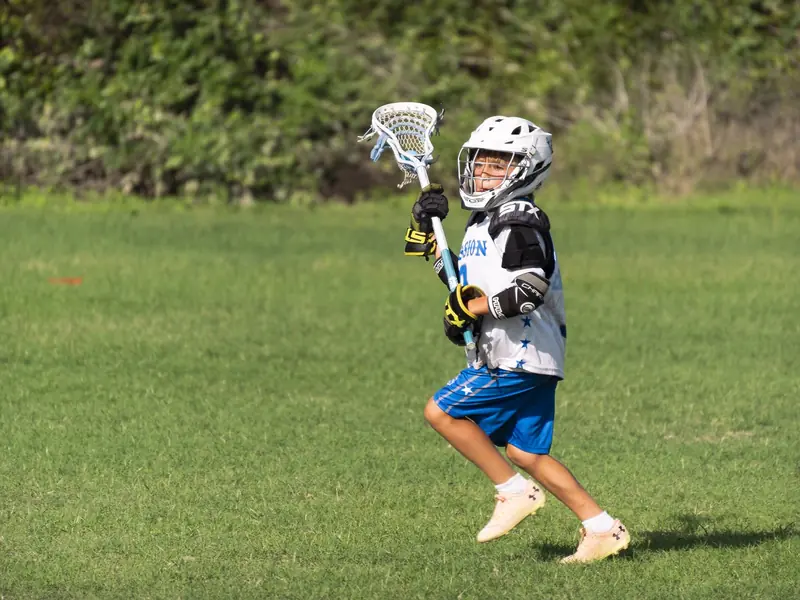
Everything you need to turn a backyard into a training facility is below.
A backyard with a plan and the right equipment turns loose time outside into real training. Your backyard setup is the training infrastructure your kid needs to succeed, and building it is almost entirely a parent’s job.
This page covers every piece, how many of each, why it matters, and exactly which ones to buy. Nothing here is decorative.
1. What consistency actually adds up to
Here is the math that makes this whole page worth reading.
| If your player does this | Over this stretch | They bank |
|---|---|---|
| Two 20-minute sessions a week | 16 weeks — end of spring season to fall tryouts | About 11 hours |
| Two 30-minute sessions a week | 16 weeks — end of spring season to fall tryouts | 16 hours |
| Two 30-minute sessions a week | 40 weeks — one spring season to the next | 40 hours |
Twice a week. Thirty minutes. That is the whole ask, and it turns into forty hours with a stick in their hands over a year.
What makes those hours valuable is that nobody has to schedule them, nobody has to drive to them, and they are entirely within your family’s control. They happen in your yard, on your time, in the months when nothing else is going on.
Parents: almost everything on this page is something only you can provide, and it sits alongside the rest of what your job looks like as a lacrosse parent. Meet the goals below and you are handing your athlete an advantage that compounds every single week.
Players: you have a real chance to build the best stick skills in this city without ever leaving your backyard. Follow the workouts, use the equipment, and become the best player in San Antonio.
2. The three-step plan
| Step | What you do |
|---|---|
| Step 1 | Plan the space. Measure it. Decide where the goal goes, where the rebounder goes, and what stops a missed shot. |
| Step 2 | Budget and purchase. Section 8 has three complete builds at three price points. |
| Step 3 | Run the workouts at home. Wall ball, shooting and ladder work — all three are written out and free. |
2.1 The goal of the setup, in one line
A rebounder for passing and catching. A goal and balls for shooting. An agility ladder for athleticism. That is the whole target.
| Essential — you want all three | Additional — add as you can |
|---|---|
| 1 goal | Shooting targets |
| 1 rebounder | Backstop net |
| 60–120 balls | Agility ladder |
| A girls stick for training |
A backyard laid out to train: goal, backstop, wall and rebounder.
3. Essential: the goal
Quantity needed: 1.
Why you need it: a goal is how a player builds shooting power and accuracy, and it is the piece that makes a kid want to go outside without being asked. Every position shoots — attack, midfield, and defensemen who end up with the ball in transition.
3.1 Three buying rules
- Buy the 6′ × 6′ outdoor size. That is regulation at every level from 6U to the pros. A 4′ × 4′ indoor goal is a useful add-on for tight spaces, and the 6×6 is the one to build around.
- Look for a fixed frame rather than a folding one. Fixed frames hold their shape season after season, which is what you want from something living outside year-round.
- Skip the “game goal.” Those are built for a field crew with a truck. A backyard goal is lighter, costs less, and does the same job in your yard.
The one measurement to walk in with. 6′ × 6′ is the regulation goal size at every level from 6U to the pros, so a 6×6 in the yard is the one your player will still be shooting on in high school. A 4′ × 4′ is a useful extra for a tight space, not the thing to build the setup around.
3.2 Which goal to buy
| Goal | Cost | Note |
|---|---|---|
| Crank Shooter Backyard Goal | $150 | Quick-clip netting, sets up in about 90 seconds |
| Lacrosse Balls Direct Backyard Goal | $150 | Straightforward, well priced |
| Franklin Sports Backyard Goal | ~$100 | The most affordable regulation-size option. Also stocked at Academy locally |
| Powell / Gladiator Goal | $200 | Heavier build, longer life |
| Warhog Quad Pocket | $250 | A 4×4 that fits inside your 6×6. Turns an open net into four corners — a target and a goal in one |
4. Essential: the rebounder
Quantity needed: 1.
Why you need it: a rebounder is a training tool for building passing and catching skills. It was built to deliver the maximum number of reps in the shortest amount of time in a confined space. The ball returns at a usable height and angle, which means a twenty-minute session is twenty minutes of repetitions instead of twelve minutes of reps and eight minutes of walking.
| Rebounder | Cost | Note |
|---|---|---|
| Baseball bounce-backs (Prime, at Dick’s) | ~$30 | A great low-cost option. Buy as many as you can — perfect for a young player, and affordable enough to have several |
| Champro Rebounder Screen | $109 | The most affordable dedicated lacrosse rebounder |
| STX Multi-Position Rebounder | $144.99 | Adjustable angle — flat for ground balls, upright for passing |
| STX Bounce Back | $199.99 | Larger rebound surface |
| Champion Sports Pro Rebounder Wall | $275.74 | Top of the family-buyable range |
4.1 A wall works too, and it does a different job
A wall is the other half of this. A basketball gym, a racquetball court, a school wall or the side of a garage will build the same hands, and it is free.
A tall wall — three or four stories — adds something a rebounder cannot: more hang time on the return, which forces a player to catch in the upright overhand position, and enough surface to rip a full-power shot from thirty yards back. If you have access to one, use it. Use both if you can — the rebounder is what is in the yard at 6 p.m. on a Tuesday, and the wall is where the big sessions happen.
5. Essential: the balls
Quantity needed: 60 to 120 for shooting. 10 for wall ball. One ball bag holds 60. One box holds 120.
The reason for the big number is rhythm. With 60 to 120 balls, a shooting session is shot after shot after shot, and the mechanics start to groove. With a dozen balls, a player still gets real work in — it just becomes shoot, walk, collect, repeat. If you are starting with a small bucket, use those sessions for form and technique, then add balls as you go and let the volume build.
Why the ball count is the piece parents underestimate. Sixty to 120 balls is what turns a shooting session into shot after shot instead of shoot, walk, collect, repeat. Ten balls is all wall ball ever needs — the big number is for the goal.
Where to buy: LacrosseBallsDirect.com — about $165 for 120 balls, one of the lowest prices we have found. Reach out to Coach Paul directly and we can add you to a bulk team order.
6. Additional: targets, backstop, ladder and a girls stick
6.1 Shooting targets
Quantity needed: 1 to 4. A shooting target sits in the goal mouth and leaves only the corners open. It turns aimless shooting into practice with a score, and the more accurate the shooter the better the player.
It is also what keeps a kid out there for twenty minutes instead of four — scoring against a target is a game, and shooting at an open net is not.
Gladiator Lacrosse targets · ECD Shooting Target · Universal Lacrosse target range. Any of them makes an easy birthday ask, and there are more ideas in the lacrosse gift guide.
6.2 Backstop net
Quantity needed: 1 to start. Add a second as they grow older and start missing harder and farther.
A backstop is netting that stops anything that gets past the goal. It makes picking up balls after a shooting session dramatically faster, and it keeps balls out of the neighbor’s yard. It works behind a rebounder for the same reason.
Smart Backstop — $300, attaches directly to the goal · Lacrosse Scoop Backstop — $200, 10′ × 20′.
6.3 Agility ladder
Quantity needed: 1. Any agility ladder will do the job — they are inexpensive, widely available, and the differences between them barely matter. Grab one online or at any sporting goods store.
Why it matters: ladders build coordination at the youth level — specifically body control and moving the opposite arm with the opposite leg, which is the exact pattern one-handed cradling requires.
SKLZ makes a tangle-free version we like, and there are plenty of good ones.
6.4 A girls stick, for training
A girls stick has a shallower pocket and far less forgiveness, which means it demands faster, cleaner hands. That is exactly what makes it a training tool.
Watch Coach “Z” — John Zulberti, who invented wall ball and was a four-time All-American at Syracuse — hit the wall with one. If it is good enough for him, it is good enough for a Tuesday afternoon in your yard.
STX Crux 100 is the pick. Or buy one used on SidelineSwap — this is a training tool, not a game stick, and used works perfectly.
7. The gear they train in
7.1 Sticks — 1 to 2
Your player needs one game-ready stick to practice with, so the stick they use in a game is the same one they have been training with all week. Sizing and the rest of the kit are covered in the beginner gear guide. As they grow older, carry two game sticks — if one breaks mid-game there is a backup on the sideline ready to go.
Recommended: StringKing Complete 2 (the Complete 2 Jr runs about $70 and comes in a more pinched version) · Powell complete sticks · RC1 Complete.
7.2 Two stick details most parents never hear
- Loosen the throat strings so the ball sits right at legal depth. The ball should still pop out high enough that there is no excessive whip — you want it releasing clean, not diving into the dirt. They need to learn to reach back.
- Leave the shaft untaped. Players slide their hands constantly — the top hand comes off and the bottom hand slides up, especially off ball. A bare shaft is what lets that happen.
Two five-minute fixes on a brand-new stick. Loosen the throat strings so the ball sits at legal depth and releases clean instead of diving, and leave the shaft untaped so both hands can slide the way the game actually asks them to. Neither costs anything, and most parents never hear either one.
7.3 Helmet and gloves — worn every session
Practice how you play. A helmet and gloves in the backyard means every rep looks like a game rep, and the hands grow used to catching in gloves rather than out of them.
It also means a stray pass is a non-event, which is exactly what you want when a kid is learning to catch.
Put the player’s name on tape across the back and sides of the helmet. At the youth level, calling for the ball does not always work — sometimes a teammate has to shout a name to make a pass happen.
8. Three complete builds
| Build | What is in it | Cost |
|---|---|---|
| Starter | Baseball bounce-back (~$30) + Franklin 6×6 goal (~$100) + one bag of 60 balls | ~$220 |
| The real setup | STX Multi-Position Rebounder ($145) + Crank Shooter goal ($150) + 120 balls ($165) + shooting target | ~$510 |
| Complete | The above + Lacrosse Scoop backstop ($200) + agility ladder + a used girls stick | ~$760 |
Put that number next to what it buys. A complete backyard setup is a one-time purchase that works for every kid in the family, outlasts growth spurts, and lasts years. It costs about what one season of travel club costs, and it is available every single day of the year.
9. Go build it
A goal, a rebounder, and a bag of balls. That is the whole thing. Everything else on this page makes those three work harder.
Once it is up, the workouts are written out and free — wall ball, shooting and ladder, all of them on this site with the reps and the drills spelled out, and the drill and video library shows what each one is supposed to look like.
Build it once, and your kid trains for the next six years without you driving anywhere.
Paul Taylor
Varsity Head Coach, Central Catholic High School
Founder, Great American Lacrosse
Paul Taylor is the varsity head lacrosse coach at Central Catholic High School in San Antonio and the founder of Great American Lacrosse, which runs the SA Armadillos club teams and the Summer Showdown Camp. He has coached lacrosse in San Antonio for over a decade.
Train with Great American Lacrosse
Great American Lacrosse runs year-round programs in San Antonio — the Speed & Skills Clinic, the SA Armadillos club teams, winter rec, personal training, and the Summer Showdown Camp. Open enrollment, every level, beginners welcome.