

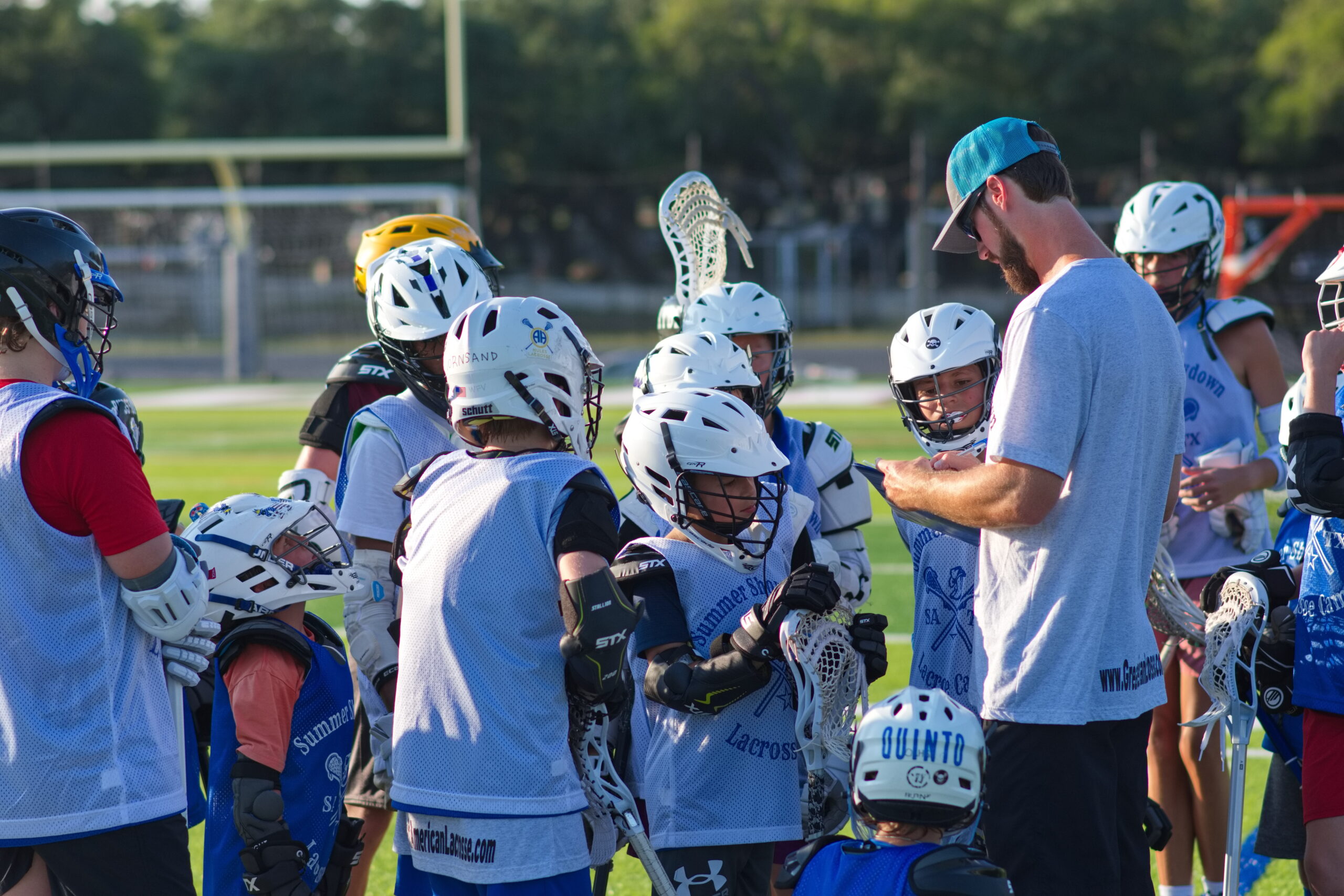
Your son’s teammates keep talking about “club,” and nobody has told you what it is, when it happens, or what it costs. Here is the whole layer, in plain numbers.
Club lacrosse has no season on the school calendar and no explanation handed to parents at signup. It is also where a large share of the games, the coaching hours and the college recruiting in this sport actually happen. Every number below is verified.
1. What club lacrosse is, and how it fits around the school season
Club lacrosse is a team a player joins outside his school, run by a program rather than a school district, that plays a schedule of weekend tournaments. He tries out, he is placed on a roster, and the team travels together to multi-game weekends.
Club does not compete with school ball for the calendar. It fills the months school ball leaves empty.
| Season | Who runs it | What it is |
|---|---|---|
| Spring | School or high school league | The high school season — in Texas, the THSLL. A district, a standings table and a state tournament. |
| Summer | Club program | Club season one. Regional and national tournaments, the biggest travel weekends of the year. |
| Fall | Club program | Club season two, usually called fall ball. Shorter, closer to home, heavier on development. |
| Winter | Rec leagues, clinics, individual work | Small-sided leagues, skills clinics and wall ball. |
Rec or town lacrosse is the entry level: local, low cost, everybody plays, opponents from the same city. Club is the next layer up: a tryout, a fixed roster, opponents from other states. School ball is separate from both and is the only one that produces a school championship.
Club does not replace school ball, and school ball does not replace club. They run in different months and do different jobs. A high school player in a strong program plays both, and a fifth grader can play rec in the spring and club in the fall with no conflict at all.
1.1 Why club exists at all
The first reason is games. A youth rec season might give a boy eight games against the same handful of local teams. One club tournament weekend gives him four or five in two days against teams he has never seen. Repetition against unfamiliar opponents builds a player faster than anything else in the sport, because it removes the option of relying on habit.
The second is that college recruiting happens at club events, not high school games. A coach can evaluate forty prospects in one afternoon at a club tournament, or fly to a high school game and watch one. The economics decide it — and that reason starts to matter around sophomore year, not before.
2. Grad-year teams: why it is “the 2031s” and not “the seventh grade team”
Club rosters are labeled by high school graduation year. A 2031 team is boys who graduate in 2031, which today means seventh and eighth graders. Two reasons, both about clarity.
- Recruiting is organized by class. A coach recruits “the 2029s,” not “the juniors,” because a junior in October is a senior nine months later. Grad year never goes stale.
- Grade labels break. Boys repeat years, reclassify, or start school late. Two boys can both be eighth graders and graduate a year apart.
How to translate a grad year in one step. Subtract 12 from the graduation year — that is the fall the class started first grade. In the fall of 2026, a 2033 team is fifth and sixth grade and a 2029 team is sophomores.
3. Tryouts: when they happen and what a coach is watching
Club tryouts run on the club calendar, not the school one. Tryouts for the fall season are held in late summer or early fall; tryouts for the summer season in the winter or spring. A family shopping for a club in June has usually already missed the summer roster.
3.1 What to bring
Full game equipment, cleats, a mouthguard, water, and a stick he has actually been using. Nothing new on tryout day — a stick strung yesterday throws differently than the one he has used for six months.
3.2 What a coach is actually evaluating
The list is shorter and more mechanical than most parents expect, and scoring is not on it.
- Catching and throwing with both hands. A boy who can only go right is a boy every defense can take away. The most visible thing at a tryout.
- Off-ball movement — what he does in the ten seconds he does not have the ball, which is most of the game.
- Ground balls. Whether he goes after a loose ball at full speed with someone else arriving at the same time.
- Coachability. Whether a correction from a coach he met an hour ago changes what he does on the next rep.
- Effort between drills. Coaches watch the walk back to the line.
3.3 What a parent should expect
Most tryouts run 90 minutes to two hours across one or two sessions. Expect a decision within a week or two, placement onto a team rather than a yes or no at larger programs, and a deposit before the season starts, because the program enters tournaments months in advance.
4. A tournament weekend, hour by hour
This is the part no one describes to a first-year family, and the part that reshapes the calendar.
| Time | Saturday |
|---|---|
| 6:15 a.m. | Uniform on at the hotel. Nowhere to change at the fields. |
| 7:30 a.m. | Team arrival, 45 to 60 minutes before faceoff. Parking is often a shuttle ride away. |
| 8:15 a.m. | Game one. Most youth tournament games run four short quarters and finish inside an hour. |
| 9:30 a.m. | Break — 45 minutes to four hours, and you will not know which until the schedule posts. |
| 12:30 p.m. | Game two, then a long gap or the end of the day. |
| 4:30 p.m. | Game three on a three-game Saturday, then hotel, team dinner, ice, sleep. |
| Sunday | Pool games, then playoffs. Championship brackets run into mid-afternoon, which decides your drive home. |
Structure verified against published tournament formats including the NLF National Championships, which notes games starting as early as 8 a.m. and championship play running to mid-afternoon.
What to pack: folding chairs, a pop-up shade tent, a cooler, sunscreen, a portable charger, and a second set of everything he wears. Shade is the one people forget at a July tournament in Texas.
5. The national circuit, and who each event is for
National events come in three kinds. Team tournaments are entered by a club. Individual showcases are entered by a player alone and are graded and filmed. National team pathways are open tryouts run by the sport’s governing body.
| Event | Type | When and where | Who it is for |
|---|---|---|---|
| NLF National Championships | Team | Stony Brook University, NY. Youth divisions July 9–10, 2027; high school divisions July 12–13, 2027 | Grad years 2028–2035. AA divisions invitation only; A divisions have limited openings. |
| NXT Cup | Team | Philadelphia area (Downingtown and West Chester, PA), summer | Grad years 2028–2033. One of the largest club tournaments in the country. |
| NXT Philly Summer Showcase | Individual | Downingtown, PA, summer | High school classes. Three games plus an all-star game, independent evaluators grading each player. |
| Maverik Showtime | Individual | June 14–15, 2027 | Invitation only, classes of 2028–2030. |
| USA Lacrosse Regional ID Clinics | National team pathway | January through July, at sites including Texas | U15, U17, U19. One-day, 180-minute evaluations; the top 175 players nationally advance to a National Combine. |
| NTDP National Combine | National team pathway | USA Lacrosse HQ, Sparks, MD. Boys U15 July 6–8, 2026; U17 and U19 August 3–6, 2026 | Invitation only. U.S. Youth National Team rosters are named here. |
Sources: event organizers’ own pages, read August 2026. Calendars move every year — confirm dates before booking travel.
The membership nobody mentions until checkout. Most sanctioned events require a current USA Lacrosse membership for every player. A 22U player membership is $35 a year and includes participant insurance. Buy it once and it covers the whole year. Source: USA Lacrosse.
6. What a season costs, and what it does to your calendar
Club fees are quoted as one number and are almost never what a family spends. The full picture at three stages:
| Line item | Ages 7–10 | Ages 11–14 | Ages 15–18 |
|---|---|---|---|
| Club dues | $750–$1,500 | $2,000–$4,000 | $3,000–$7,500 |
| Uniforms | $50–$150 | $100–$300 | $200–$500 |
| Equipment | $460–$1,465 | $839–$1,539 | $974–$1,639 |
| Travel, hotel and food | $1,700–$3,300 | $3,025–$5,350 | $4,850–$8,200 (includes flights) |
| Extra training | $200–$750 | $500–$1,000 | $500–$1,500 |
| Showcases and select teams | — | $500–$1,500 | $1,000–$2,000 |
| USA Lacrosse membership | $35 | $35 | $35 |
| All-in for the year | $3,195–$7,200 | $6,999–$13,724 | $10,559–$21,374 |
Source: Club Lax Life, boys club cost breakdown. National ranges built around East Coast travel. A Texas family whose club plays in-state sits at the low end of the travel line; a family flying to Maryland twice sits at the top.
Travel is the biggest line, not dues. At every age above, hotel, gas, flights and food exceed the club fee — and it is the one line you control, by picking a program whose schedule you can drive to. Full breakdown: how much youth lacrosse costs.
One number explains the dues: team entry for a single national tournament runs around $2,300, before anyone has driven anywhere. Across a 22-player roster that is roughly $105 a head, per weekend, just to be on the field.
6.1 What “travel team” does to a family calendar
The phrase sounds like distance. It means weekends. A fall club season is typically two to four tournament weekends inside about eight weeks, each one Friday evening through Sunday afternoon if the event is out of town, plus two or three practice evenings a week.
- The whole family’s weekend goes, not just the player’s. Siblings come or get covered.
- Sunday afternoons are unpredictable, because a team that keeps winning plays later. A real problem if you booked a 4 p.m. flight.
- Hotels book out. Large tournaments fill the nearby blocks months ahead, and the club usually names a team hotel. Book when the club says to.
Put the tournament dates on a shared calendar before you pay the deposit. A family who looks at that schedule and decides it is more than this year can hold is making a reasonable call. The version that goes badly is the one that never looked.
7. How to evaluate a club program
Every program says it develops players. These are the questions where answers actually differ.
| Ask this | What a real answer sounds like |
|---|---|
| How many practices per tournament weekend? | Two or three practices per tournament weekend means the team is being coached. One practice before a two-day event means it is being assembled. |
| What is the roster size? | A number, and a reason for it. Larger rosters spread the cost; smaller rosters concentrate the minutes. |
| What is your playing time philosophy at this age? | At youth ages, everyone plays meaningful minutes. At high school ages, minutes are earned. Both are legitimate — what matters is that they say it before you pay. |
| Who is the coach and what has he coached? | A playing background, a coaching history you can look up, current certification. Ask who runs practice, not who runs the club. |
| What is the tournament schedule, with dates and cities? | A published list. A schedule still “to be determined” after you pay leaves your calendar and budget open-ended. |
| What is included, and what happens if he gets hurt? | An itemized list — uniforms, entry fees and referee fees often sit outside the quoted number — and a written refund policy. |
| How many players came back from last year’s roster? | The most revealing number in the conversation. Families vote with renewals. |
8. Recruiting: what club does, and what it does not do
What club does: it puts a player in front of college coaches at events those coaches already attend, it produces film, and it gives him a coach who talks to college programs on his behalf. In a state coaches do not routinely visit, that is the whole mechanism.
What club does not do: it does not get anyone recruited by itself. A roster spot on a well-known team is exposure, not an outcome. Grades, film and a player’s own emails do work no club can do for him.
The rule that just changed, and almost nothing online reflects yet.
Division I men’s contact is no longer September 1. Coaches may first contact a recruit on the Wednesday immediately following Labor Day of his junior year, at 7:00 a.m. — effective August 1, 2026. The women’s side did not change and is still September 1, so a family with a son and a daughter now runs two different calendars. Source: NCAA Division I Men’s Lacrosse Oversight Committee, March 2026.
The odds are better than most parents assume: about 14.7% of high school boys lacrosse players go on to play in the NCAA, 3.4% at Division I. Source: NCAA estimated probability of competing beyond high school, 2024–25. And under the House settlement, Division I men’s rosters are capped at 48 players at schools that opted in. Source: USA Lacrosse. The full timeline, the scholarship math and the specific Texas problem are in the recruiting article.
9. When to start club — the honest answer
Most families start club a year or two before the player benefits from it, usually because a neighbor’s kid did.
Club pays off when a player already loves the game and has outgrown what his local schedule gives him. For most boys that is somewhere between fifth and eighth grade. Before that, the same money spent on rec lacrosse, a wall and unstructured play buys more development — because the limiting factor at eight years old is reps and enjoyment, not competition level.
Here is the encouraging part. Recruiting does not open until junior year, and the NCAA contact rules make that a hard floor rather than a suggestion. There is no advantage available at nine that is unavailable at twelve. A boy who starts club in seventh grade with real enthusiasm and two good hands catches and passes one who started in third grade and was tired of it by sixth.
Good signs he is ready: he asks to go to practice, he plays wall ball without being told, and he is disappointed when a game gets rained out. Those three predict more than any tryout. More in supporting your young lacrosse player.
10. Multi-sport athletes, and how club fits around football and basketball
- Football runs August through November and collides directly with fall ball. Most clubs treat fall as development rather than a must-attend season, and many boys join fall practice once football ends.
- Basketball in Texas starts practice October 28 for boys and runs to the state tournament in mid-March. Source: UIL tentative 2026–27 dates. Its heaviest months sit in the winter, which is the emptiest part of the lacrosse calendar. These two coexist better than almost any other pair.
- The summer club season has the fewest competing school sports, which is exactly why it became the biggest one.
Say the conflict out loud at the tryout. A program that tells you a football player will miss three weeks and still has a spot for him is telling you something useful about how it operates. College coaches have never stopped valuing multi-sport athletes.
11. The Texas and San Antonio picture
Texas club lacrosse runs on a mostly in-state circuit until the high school years, which is a real cost advantage for families here. The state’s own events are the Texas Draw in Plano in late May, which NCAA coaches attend, Best of Texas in December, and the Austin-corridor weekends most South Texas teams play — all inside driving distance of San Antonio.
Locally, Great American Lacrosse runs the SA Armadillos, built the way this article describes: four boys grad-year teams — 2031, 2033, 2035 and 2037 — plus a girls team, and all of them travel. The fall schedule is three Austin-area tournaments: Texas Thrive at the Round Rock Multisport Complex, the UT Longhorn Shootout at Whitaker Sports Complex, and the Austin Authentic at Bee Cave Sports Complex. That is what a first club season looks like in this city — three drives, no flights.
The wider local landscape is in lacrosse in San Antonio. The girls’ club layer runs on a different structure and a different calendar, and has its own article: club lacrosse explained, girls.
12. What to do with all of this
Elementary school and loves the game? Play rec, get a stick in his hands most days, and come back to this page in two years. Nothing is closing.
Middle school, asks to go to practice, out of competition locally? Club is the next step, and the program to pick is the one whose schedule you can drive to and whose coach you would want him to spend two hundred hours with.
High school with college in mind? Junior year is when the rules open, sophomore year is when the film needs to exist, and the club schedule is what puts him in the room.
Paul Taylor
Varsity Head Coach, Central Catholic High School
Founder, Great American Lacrosse
Paul Taylor is the varsity head lacrosse coach at Central Catholic High School in San Antonio and the founder of Great American Lacrosse, which runs the SA Armadillos club teams and the Summer Showdown Camp. He has coached lacrosse in San Antonio for over a decade.
Train with Great American Lacrosse
Great American Lacrosse runs year-round programs in San Antonio — the Speed & Skills Clinic, the SA Armadillos club teams, winter rec, private training, and the Summer Showdown Camp. Open enrollment, every level, beginners welcome.