

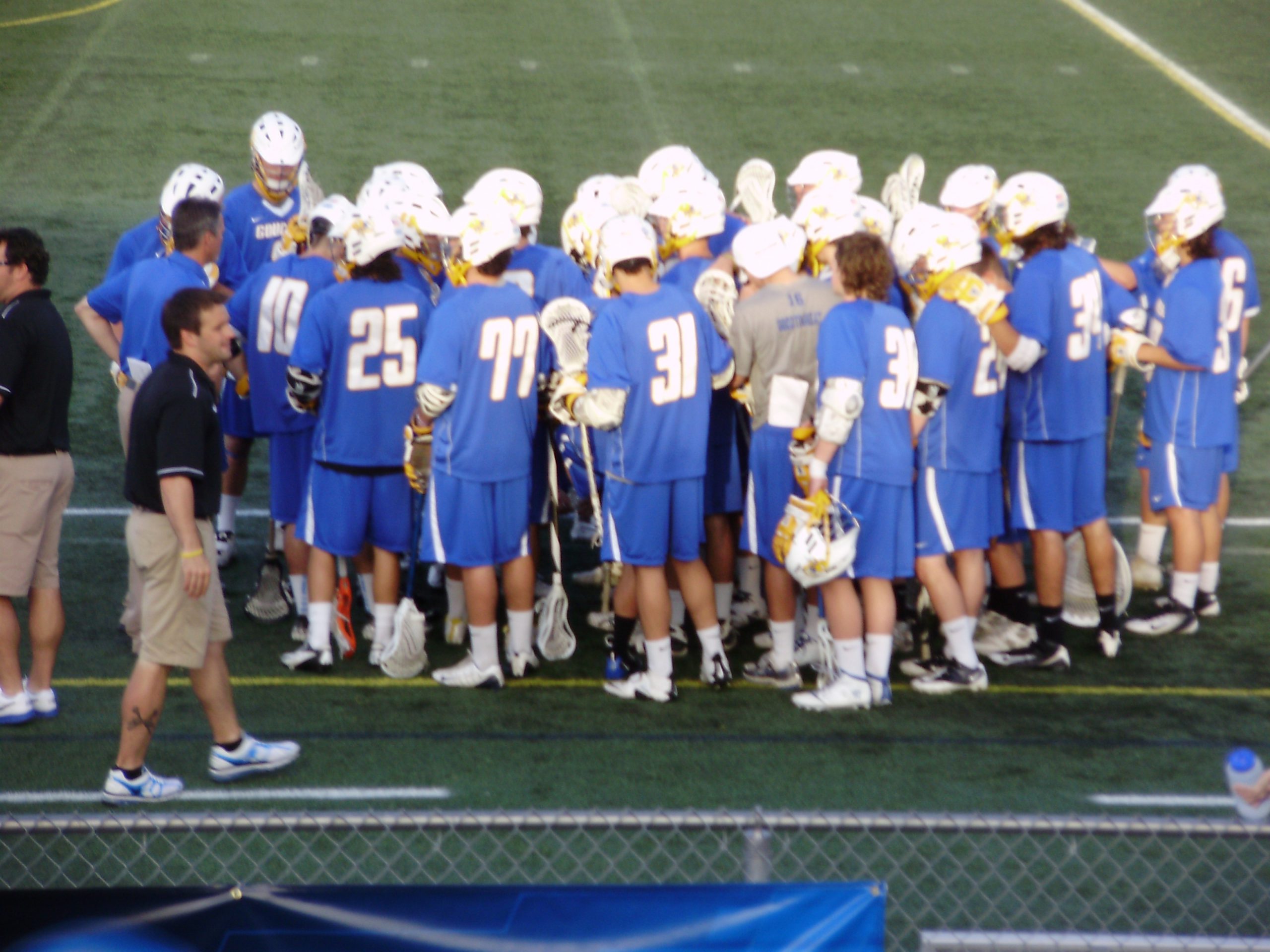
There is no such thing as “the rules of lacrosse.” There are eight sets of them, and your child will play under at least three before they graduate.
Here is what nobody tells a new lacrosse parent: the game your eight-year-old plays and the game you watch on ESPN are governed by different rulebooks — different field sizes, different clocks, different stick lengths, different contact rules. Different enough that a rule change you read about in a national article may have nothing to do with the field your kid is standing on.
This page is a map, not a manual. A short overview of each version, then a direct link to the actual rulebook so you can go as deep as you want.
How to use this page: it splits into four streams — boys outdoor, girls outdoor, box (indoor), and Olympic Sixes. Read the one your family plays. If your kid plays outdoor field lacrosse you can skip the box section entirely and nothing will be missing.
1. The master chart
Orientation only. Everything below is the detail.
| Version | Players | Clock | Contact | Shot clock |
|---|---|---|---|---|
| Boys outdoor | 10 a side | Varies by level | Body checking from 14U | Varies |
| Girls outdoor | 12 a side | Varies by level | No body checking, ever | Varies |
| Box / indoor | 6 a side | 4 × 15 min | Cross-checking legal | 30 seconds |
| Sixes (Olympic) | 6 a side | 4 × 8 min running | Limited | 30 seconds |
The four versions of lacrosse, at a glance.
2. BOYS OUTDOOR — youth and high school
2.1 Youth, by age band
The single most misunderstood rule in youth lacrosse is when hitting starts. Parents guess anywhere from seven years old to high school.
Body checking is illegal at 6U, 8U, 10U and 12U. It becomes legal for the first time at 14U.
That is USA Lacrosse’s national youth standard, and it is why a 12U game looks like fast, chaotic keep-away while a 14U game suddenly looks like the sport on television. 2026 USA Lacrosse Boys Youth Rulebook.
Field size, quarter length, ball type and stick length all scale down by age band. Long poles come in around fifth grade — roughly the 10U level — and at that age the pole is shortened rather than full length. Which players carry one, and why, is the subject of our guide to the boys positions.
2.2 High school — and why Texas is different
Most of the country plays NFHS rules. Texas does not. The Texas High School Lacrosse League says so in its own rulebook: “Games will be played in accordance with all NCAA lacrosse rules, with waivers approved at the THSLL Annual Meeting.” THSLL Rulebook 2026, §6.8.
What that actually changes, from USA Lacrosse’s own comparison chart:
- Game length. NFHS runs four 12-minute quarters. NCAA runs four 15-minute quarters. A Texas high school game is twelve minutes longer than the same game in most other states.
- Shot clock. NFHS has none nationally. NCAA runs 80 seconds — so Texas high schoolers play with a shot clock most American high schoolers have never seen.
- Field. NFHS allows a range; NCAA fixes it at 60 by 110 yards.
- Goalie out of the crease. NFHS gives a five-second grace period after a stoppage. NCAA gives none.
- Timeouts. NFHS from anywhere; NCAA requires the ball behind the offensive restraining line.
Source: USA Lacrosse NFHS vs. Collegiate comparison chart.
3. BOYS OUTDOOR — college and professional
3.1 College — NCAA men’s
Eighty-second shot clock, four fifteen-minute quarters, ten players a side, a maximum of four long poles on the field at once. Because Texas already plays this code, a Texas player is one of the few in America who does not have to relearn the clock in college.
3.2 Professional outdoor — the PLL
Four 12-minute quarters. Overtime is one sudden-victory period of up to 12 minutes, running clock, no timeouts.
The two-point arc, correctly: it is not a circle, and almost every explainer draws it as one. Fifteen yards from the center of the goal at the top and both wings, narrowing to thirteen yards at the corners. Changed in May 2023 — and the league’s own published rulebook PDF still shows the old uniform arc, which is why the wrong version keeps circulating.
The shot clock, correctly: 52 seconds on any change of possession — and a goalie save is a change of possession. The 32-second clock applies only when the shooting team recovers its own rebound, or after winning a faceoff. This gets reported backwards constantly.
4. GIRLS OUTDOOR — the constants and the four rules
This is a different sport, not a softened version of the boys game. Treating it as one is the fastest way to be wrong about it, and our complete girls lacrosse guide takes it apart properly.
4.1 The constants at every level
- Twelve players a side.
- No body checking at any level — not at 14U, not in high school, not in the NCAA.
- The draw replaces the faceoff. Sticks together at midfield, ball between the heads, both players pull up on the whistle.
- One stick length for everyone — 35½ to 43¼ inches. No long poles exist in the women’s game, which is why the girls positions are built on footwork rather than equipment.
- A shallow pocket by rule — the ball must stay visible above the sidewall.
4.2 The four rules that define the game
- Shooting space. A defender may not stand in the lane between the ball and the goal unless within a stick’s length of the ball carrier. It looks like a penalty for good defense. It is a safety rule.
- Three seconds. No defender may sit inside the 8-meter arc longer than that without actively marking someone.
- The sphere. The protected space around a player’s head — the USA Lacrosse girls youth rulebook defines it as the 12-inch area surrounding the head in all directions. No check may enter it.
- The restraining line. Offside, girls version — a maximum of seven players over the line in the offensive end, eight in the defensive end.
5. GIRLS OUTDOOR — youth through professional
5.1 Youth and high school
Stick checking is phased in gradually by age band rather than switched on. The game becomes more physical with a stick, never with a shoulder. 2026 USA Lacrosse Girls Youth Rulebook. In Texas, high school girls play under TGHSLL.
5.2 College — and what just changed
The 2026–27 NCAA women’s rules brought the biggest changes in years:
- A simplified penalty structure — all yellow cards now carry a two-minute non-releasable penalty
- A new “targeting” foul — forcible contact with no attempt to play the ball is now an automatic red card
- A 30-second draw clock after goals
- Quarter-end possession now carries into the next quarter instead of a fresh draw
Source: NCAA · full rulebook.
5.3 Professional — the Women’s Lacrosse League
Launched in 2025, playing the sixes format, and covered under the PLL’s ESPN agreement. A girl in San Antonio can now watch professional women’s lacrosse on television, which was not true three years ago.
6. The boys’ game and the girls’ game, side by side
The master chart at the top is orientation. This is the detail, and it is the version worth keeping if you have a son and a daughter both playing.
| Boys outdoor | Girls outdoor | |
|---|---|---|
| Players on the field | 10 | 12 |
| Body checking | Legal from 14U | Never, at any level |
| How play starts | The faceoff, on the ground | The draw — sticks together at midfield, ball between the heads |
| Stick lengths | Short sticks and long poles. A maximum of four long poles on the field at once | One length for everyone, 35½ to 43¼ inches. No long poles exist |
| Youth rulebook | USA Lacrosse Boys Youth Rules | USA Lacrosse Girls Youth Rules — and a pocket that is shallow by rule, so the ball stays visible above the sidewall |
| Texas high school league | THSLL | TGHSLL |
| Professional league | PLL outdoors, NLL indoors | Women’s Lacrosse League, launched 2025, sixes format |
7. The penalties, and how long they last
This is the table to look at the first time a flag goes down and nobody around you can explain it.
| Penalty | What it is | How long |
|---|---|---|
| Slashing personal foul |
Swinging the stick at an opponent with viciousness or reckless abandon | 1, 2 or 3 minutes, non-releasable — the official decides on severity |
| Cross-check personal foul |
Checking with the handle between the hands, thrust or extended away from the body | 1, 2 or 3 minutes, non-releasable |
| Tripping personal foul |
Obstructing an opponent at or below the waist with stick, hands, arms, feet or legs | 1, 2 or 3 minutes, non-releasable |
| Illegal body check personal foul |
Contact on a player without possession, from the rear, or above the shoulders or below the waist | 1, 2 or 3 minutes, non-releasable |
| Unnecessary roughness personal foul |
Excessively violent contact, including a take-out check | 1, 2 or 3 minutes, non-releasable |
| A check to the head or neck personal foul |
Contact initiated to the head or neck area | Time served plus an automatic ejection |
| Holding, pushing, interference, warding technical fouls |
Impeding an opponent, shoving from behind, blocking a player without the ball, or using a free hand on an opponent | Loss of possession, or 30 seconds non-releasable |
| Offside, illegal procedure, crease violation technical fouls |
Too many players over a restraining line, a rule-mechanics violation, or entering the crease illegally | Loss of possession, or 30 seconds non-releasable |
| Yellow card NCAA women’s, 2026–27 |
Any card-level foul under the new simplified structure | Two minutes, non-releasable |
| Targeting NCAA women’s, 2026–27 |
Forcible contact with no attempt to play the ball | Automatic red card |
Sources: 2026 USA Lacrosse Boys Youth Rulebook · NCAA. Durations and mechanics vary by level, so read the book that governs your child’s field — and if you want to understand the call rather than argue with it, start with our guide to the officials.
8. BOX — indoor lacrosse
Box is lacrosse in a hockey rink, and it is the reason Canadian players arrive with better hands than everyone else.
- Five runners and a goalie. Boards instead of sidelines.
- A goal that is 4 feet 9 inches by 4 feet, not 6 by 6.
- A 30-second shot clock.
- Cross-checking is legal. There is no offside. There is nowhere to run.
Every possession is a decision made in traffic under a clock. That is why box players show up to field lacrosse looking like they have played an extra five years.
Fun fact: box lacrosse was invented to fill empty NHL arenas during the Great Depression. Arena owners needed summer revenue for their hockey buildings. By 1931 the Montreal Canadiens and the Montreal Maroons — yes, those NHL franchises — fielded professional box lacrosse teams.
The professional league is the NLL, which runs winter into spring, opposite the PLL’s summer season. There is a women’s box game as well, including a US women’s box national team, though it is far smaller.
9. SIXES — the Olympic format
World Lacrosse invented Sixes on May 19, 2021 for one reason: to make lacrosse small enough, cheap enough and fast enough that the IOC would say yes. It worked. Sixes is what is being played at the 2028 Olympics.
- Six a side — five runners and a goalie
- A field roughly 70 by 36 meters, about a quarter of a full pitch
- Four 8-minute running quarters, 30-second shot clock
- Everyone plays both ways. No attack, no defense, no faceoff specialist.
Two Sixes rules that surprise everyone.
There is no faceoff after a goal — the goalie who was just scored on retrieves the ball and restarts. A draw happens only at the start of each quarter.
Sticks are capped at 100 to 110 centimeters, which mathematically excludes long poles. There is no long-stick midfielder at the Olympics. There cannot be.
World Lacrosse Sixes Rulebook.
And the myth to kill: there is no two-point arc in Sixes. Every goal is worth one. The two-point arc is a PLL invention and it gets misreported as Olympic constantly.
10. Where all of this came from
Every rulebook on this page descends from one document, written by a dentist.
William George Beers founded the Montreal Lacrosse Club in 1856 and codified the modern rules in 1867 — shorter games, fewer players, a redesigned stick, a rubber ball — and helped found the National Lacrosse Association the same year. He also founded Canada’s first dental journal and its first dental college. The Canadian Encyclopedia.
The game he wrote down was already a thousand years old. Traditional Indigenous games fielded anywhere from 100 to 1,000 players a side, ran sunup to sundown across multiple days, and used goals set as far as six miles apart. Passing was considered a trick. Dodging a man was considered cowardly — you were expected to run through him. Jesuit missionary Jean de Brébeuf documented Huron games in 1637; the frontiersman James Smith documented another in 1757.
Fun fact. Most people assume hockey is simply Canada’s sport. By federal law — the National Sports of Canada Act, 1994 — ice hockey is Canada’s national winter sport and lacrosse is its national summer sport. It took Parliament roughly three decades of on-and-off debate to settle it. Justice Laws Website, Government of Canada.
11. Every official rulebook, in one place
Almost all of these are free.
- USA Lacrosse Boys Youth Rules 2026 — free PDF
- USA Lacrosse Girls Youth Rules 2026 — free PDF
- THSLL Rulebook 2026 — the one that governs Texas boys high school
- NCAA Men’s Rules — free PDF
- NCAA Women’s Rules — free PDF
- World Lacrosse Sixes Rulebook
- NFHS vs. NCAA comparison chart
- NFHS books are purchase-only, about $12: boys · girls
12. Now go watch a game
You do not need to know every rule. You need to know which rulebook governs the field in front of you, and roughly what that book allows. Everything else you pick up over a season of Saturdays — helped along by our guide to watching lacrosse and the glossary of terms you will hear yelled from the sideline.
And when a flag goes down and the parent next to you says the officials in this league do not know what they are doing — you will be the one who knows Texas plays a different rulebook than the video they watched last night.
Paul Taylor
Varsity Head Coach, Central Catholic High School
Founder, Great American Lacrosse
Paul Taylor is the varsity head lacrosse coach at Central Catholic High School in San Antonio and the founder of Great American Lacrosse, which runs the SA Armadillos club teams and the Summer Showdown Camp. He has coached lacrosse in San Antonio for over a decade.
Train with Great American Lacrosse
Great American Lacrosse runs year-round programs in San Antonio — the Speed & Skills Clinic, the SA Armadillos club teams, winter rec, private training, and the Summer Showdown Camp. Open enrollment, every level, beginners welcome.